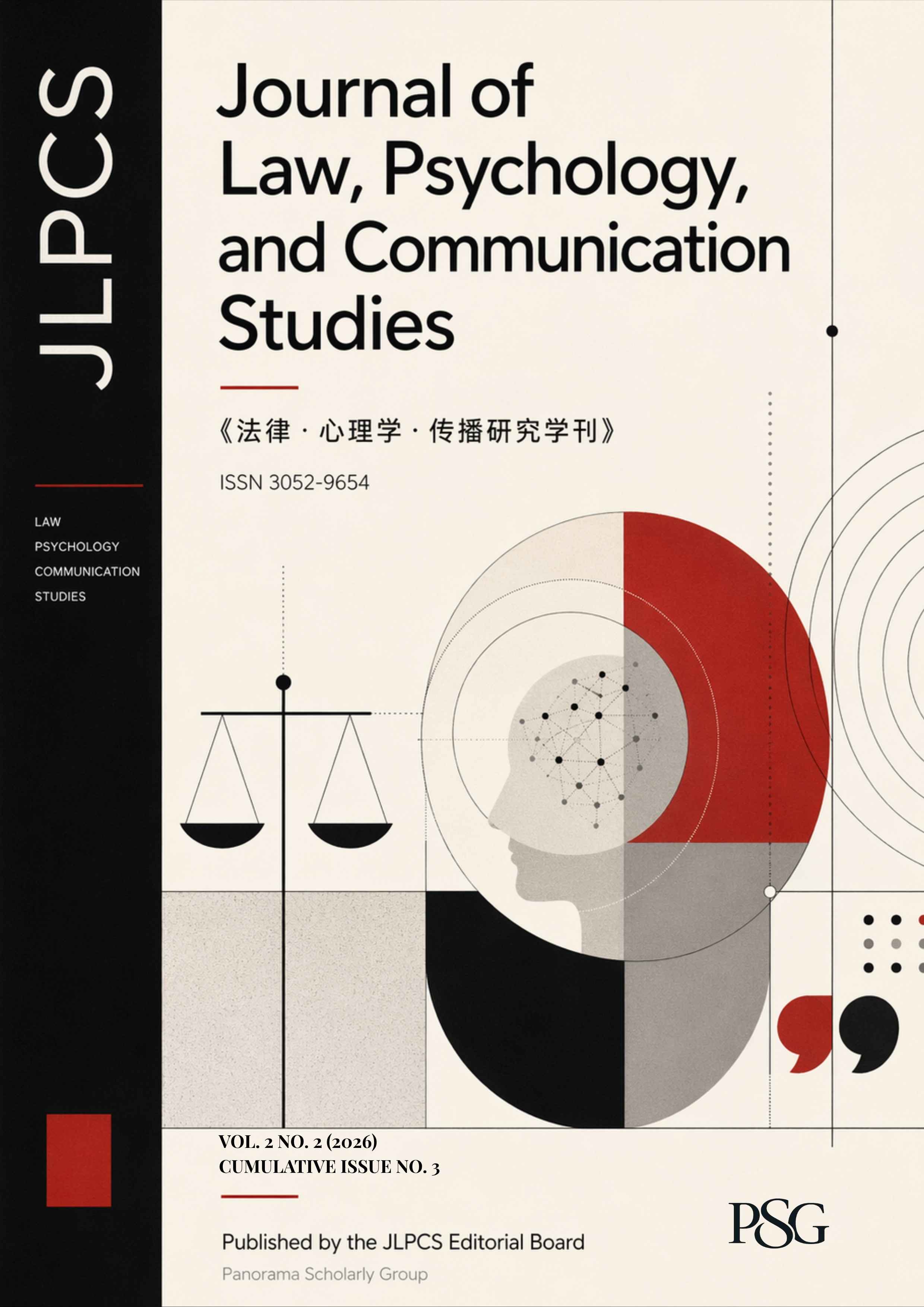
Journal of Law, Psychology, and Communication Studies (JLPCS) is an international, bilingual academic journal published by the JLPCS Editorial Board. Dedicated to interdisciplinary scholarship, the journal explores the intersections of legal systems, psychological processes, and communication practices. JLPCS publishes original, methodologically rigorous, and socially relevant research, offering both regular issues in Chinese and English as well as thematic special editions. Welcoming global contributors, the journal provides a platform for advancing theory, informing practice, and fostering cross-disciplinary dialogue in law, psychology, and communication studies.
Vol. 2 No. 2 (2026): "开盒"与青少年数字暴力:法律回应、心理机制与传播责任 / Doxxing and Digital Violence Against Adolescents: Legal Responses, Psychological Mechanisms, and Media Responsibility
View All Issues
Journal of Law, Psychology, and Communication Studies (JLPCS) ISSN: 3052-9654
A rigorously peer-reviewed academic journal dedicated to advancing scholarly inquiry within the distinct fields of law, psychology, and communication, as well as their dynamic intersections. The journal seeks to promote cutting-edge scholarship that explores foundational theories, institutional processes, social behaviors, and communicative practices through theoretical innovation and methodological rigor.
Scope of the Journal
-
Legal Studies Jurisprudence and legal theory, judicial systems, legal interpretation, law and technology, socio-legal approaches.
-
Psychological Research Social and developmental psychology, cognitive processes, mental health studies, behavioral sciences.
-
Communication Studies Communication theory, media effects, digital communication, public discourse, communication ethics.
-
Interdisciplinary Topics Legal psychology, media regulation, behavioral governance, policy communication.
Submission Criteria: JLPCS welcomes high-quality manuscripts in both English and Chinese. Submissions must demonstrate clear theoretical grounding and robust methodological design, including empirical, qualitative, or mixed-methods approaches.
All citations must conform to the APA 7th edition referencing style.